


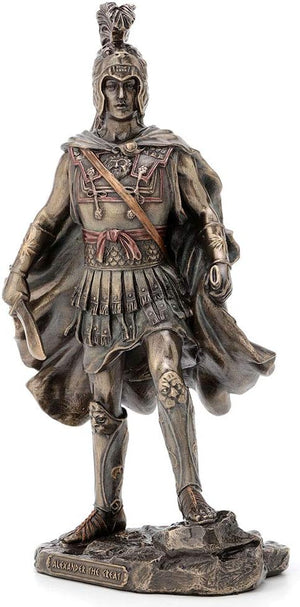
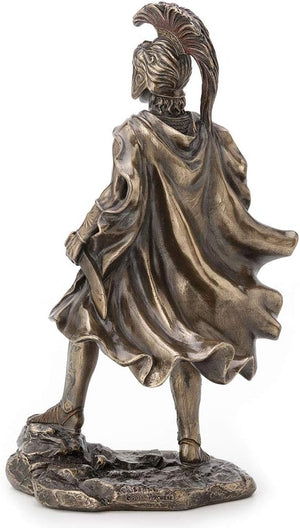
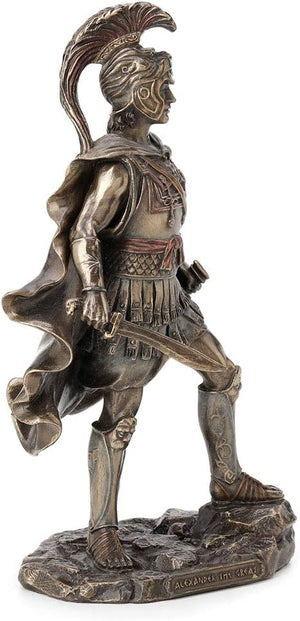
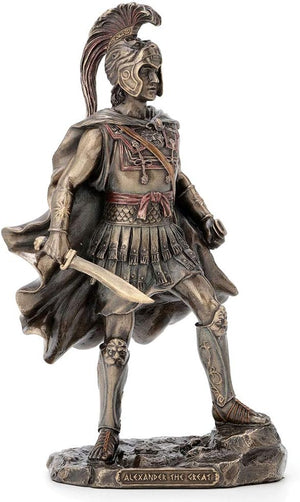
Alexander the Great with Sword and Flowing Cape
Alexander the Great – King of Macedon, pupil of Aristotle, and one of the greatest commanders in human history, founder of an empire stretching from Hellas to the Indus, the triumphant ruler who, before the age of thirty, reshaped the map of the known world in barely a decade – is shown here in a fully dynamic yet dignified martial pose, in a moment of calm confidence after a battle won. In his right hand he holds a short, curved kopis sword, the characteristic blade of the Hellenistic army, suited for both slashing strokes and thrusts in close combat. The figure is clad in ceremonial Hellenistic armour – a muscled cuirass (thorax stadios) adorned with relief work, a scaled belly guard, the distinctive pteryges – the leather-and-metal strips protecting hips and shoulders – and a red royal sash knotted in folds at the waist. His head is shielded by the famous lion-head helmet, a deliberate echo of Heracles, whom Alexander claimed as his mythical ancestor, crowned with a tall crest in deep purple and silver. From his shoulders flows a great cape sweeping outward to the sides, contrasting dynamically with the warrior's poised stance and lending the composition an almost cinematic theatricality. The entire sculpture is handcrafted, which makes every piece truly one of a kind – subtle variations in patina, the intensity of the red on the sash and plume, the depth of shadow within the folds of the cape, and the warm copper highlights upon the armour ensure that each figure carries the individual trace of the artist's hand. The surface is finished in a warm bronze-copper patina with a darkened, almost antique tone that brings out, with extraordinary precision, the meticulous details of the equipment – every element of the cuirass, every scale, every decorative buckle, and every lion's head upon the greaves. Crimson-red accents on the sash and plume create a subtle yet expressive contrast with the cooler bronze backdrop of the armour, while the sweeping motion of the cape lends the whole composition a monumental sense of grandeur. The pedestal, in the form of a rocky terrain, is crowned with the gilded plaque "ALEXANDER THE GREAT," reinforcing the monumental, collector's quality of the work. This is a sculpture of strong, sovereign presence – ideal for a private study, a library, an elegant living room in a classical or historical style, for interiors inspired by the antique and Hellenistic aesthetic, or for the desk of an enthusiast of ancient history, military culture, the lives of great commanders, or classical literature. It brings into any interior the atmosphere of royal gravitas, strategic insight, unwavering ambition, and that singular charisma which compelled men to cross the Euphrates, the Tigris, and the Hindu Kush in the footsteps of a single individual, becoming an object that is not merely decorative but profoundly symbolic – a sign of the spirit of conquest, intellectual greatness, soldierly brotherhood, and that rare form of military genius which unites personal courage with strategic wisdom and an inexhaustible will to push beyond the limits of the possible.
