


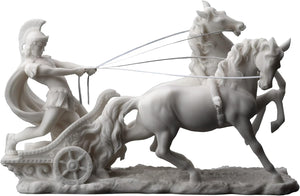
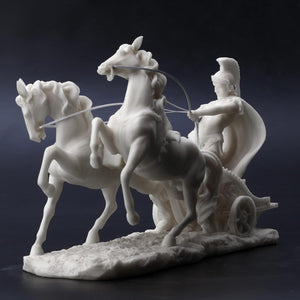
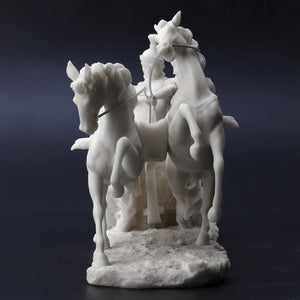
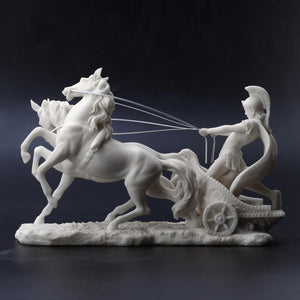
Roman Chariot – Marble Biga with Charioteer and Steeds
The Roman chariot – the biga, drawn by a pair of spirited horses – captured here in a spectacular, almost cinematic moment of headlong rush, this time presented in a classical, alabaster-white form that draws upon the finest traditions of ancient and Neoclassical sculpture. The charioteer, clad in a light tunic with pleated pteryges, the iconic crested helmet, and a cloak streaming behind him, leans back with all his strength, pulling on the reins to master the wild horses, their muscular bodies straining in a frenzied gallop. Every detail of the composition has been worked with meticulous precision – the flowing manes and tails of the steeds, the textured surface of their flanks, the scaled harness with its metal buckles, the ornate flank of the chariot with its mythological relief, and the wheel with its finely detailed spokes. The entire scene unfolds upon a wave-like terrain that captures the dynamic energy of the Circus Maximus and the battlefields of the Roman legions. The entire sculpture is handcrafted, which makes every piece truly one of a kind – subtle variations in surface texture, the depth of shadow within the folds of the cloak, and delicate ivory tones throughout the material ensure that each figure carries the individual trace of the artist's hand. The surface is finished in a matte, almost porcelain quality with a warm, creamy-white tone that subtly evokes the appearance of polished Carrara marble – the material from which, for centuries, the most extraordinary works of classical sculpture have been carved. The absence of polychromy and the pure, monochromatic palette emphasise the plasticity of the form and allow the eye to dwell in full concentration on the sculptural composition itself – the play of light and shadow upon the musculature of the horses, the folds of fabric, the dynamics of movement. The composition stands out for its exceptional horizontal structure, lending it an almost narrative, storytelling quality – a frame of ancient drama frozen in time. This is a sculpture of exceptionally dignified, classical presence – ideal for a representative living room in a palatial, Neoclassical, glamour, or minimalist style, for a private study, a library, an elegant hallway, or the desk of an enthusiast of Roman history, ancient art, equestrianism, or collector's sculpture. It brings into any interior the atmosphere of the great spectacles of antiquity – the races of the Circus Maximus, the triumphal processions of emperors, and the heroic clashes of the era – becoming an object that is not merely decorative but profoundly narrative and timeless, a sign of strength, speed, the will to win, and that singular elegance which, in pure classical white, finds its most distilled expression.
